



Endometriosis is a condition that occurs when tissue similar to the uterine lining grows outside the uterus, often causing severe pain, infertility and complications that range from gastrointestinal complaints to chronic inflammation. It affects an estimated one in 10 reproductive-age women, yet the condition remains difficult to understand, diagnose and treat.
A new collaborative grant awarded to The University of Texas at San Antonio scientists Anne Porter, MD, and Kate Lawrenson, PhD, aims to close that gap by building one of the region’s most detailed clinical and biological profiles of the disease. Porter is an assistant professor in the Department of Obstetrics and Gynecology and a minimally invasive gynecologic surgeon, and Lawrenson is an associate professor in the Department of Obstetrics and Gynecology, director of the OB/GYN Tissue Repository and Database, co-director for the Center for Inherited Oncogenesis and associate director for the Office of Postdoctoral Affairs in the Joe R. and Teresa Lozano Long School of Medicine.
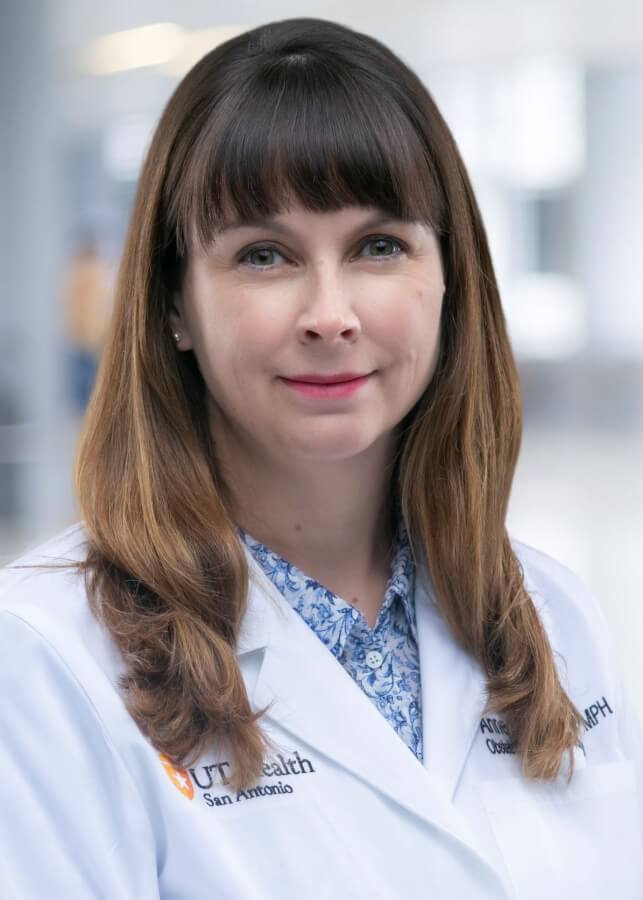
“One of the challenges in developing new treatments is how varied the presentation can be,” Porter said. “That includes differences in symptoms, differences in where it appears in the body and differences in the biochemical profile. We’re hoping to create profiles of endometriosis that help us understand those variations.”
Funded by the San Antonio Medical Foundation, the one-year award launches an effort to better capture the many ways endometriosis presents. The goal is to establish a foundation for a long-term, multi-institutional, statewide cohort that can accelerate new discoveries and better treatment options.
A collaboration years in the making
Porter’s clinical focus is complex benign gynecologic conditions, including endometriosis. After completing medical school at the Long School of Medicine, she returned in 2020 to focus on patients facing chronic pelvic pain, abnormal bleeding and related conditions.
Lawrenson joined the Long School of Medicine after a successful research career where she led high-impact genomic research and partnered closely with clinicians who treat endometriosis. Porter was familiar with Lawrenson’s work even before her recruitment, and their collaboration took shape quickly.
“I had been interested in building an endometriosis cohort, which is what she specializes in, so it was a natural fit,” said Porter.
Building a comprehensive patient cohort
The San Antonio Medical Foundation created the collaborative grant program to strengthen research partnerships across institutions. For Porter and Lawrenson, that mission aligns with the complexity of endometriosis, a condition that affects multiple organ systems and demands input from clinicians, scientists and specialists across many fields.
With the support of the grant, the team is constructing a detailed patient cohort that combines biological samples, clinical data and patient-reported information. Blood samples will allow the measurement of peripheral biomarkers, while tissue collected during surgeries can be used for genomic and gene-expression studies. Patients will complete extensive clinical questionnaires to document symptoms, pain patterns and disease course, and surgical or imaging findings will be incorporated when available.
Why understanding endometriosis is so challenging
Despite the prevalence of endometriosis, the average patient waits 10 to 15 years from the onset of symptoms to a confirmed diagnosis.
Symptoms can vary dramatically among patients, which means many individuals do not immediately fit a typical diagnostic pattern. Surgical evaluation is still the definitive way to confirm the diagnosis, which can delay assessment.
Porter hopes this work encourages broader awareness in the medical community.
“Endometriosis can present in so many different ways that patients often seek many different providers,” she said. “I really want folks to keep that in mind when patients come to someone other than a gynecologist, because it can affect so many organ systems.”
The disease has a strong genetic component. People with a family history are seven times more likely to develop endometriosis, although genetics alone cannot explain all cases. Environmental factors, chronic inflammation and stress also appear to influence how the condition develops and progresses.
The need for better treatment options
Current treatment choices for endometriosis remain limited. Many patients first try nonsteroidal anti-inflammatory drugs, then experiment with various hormonal medications. Some are offered medications that induce a temporary medical menopause, though these treatments are typically short-term. Surgery remains both a diagnostic and therapeutic option, but not all patients respond fully and some experience lasting chronic pain even after lesions are removed.
“We simply don’t have enough treatment choices,” Porter said.
Understanding immune dysregulation at the core of the disease is one of the research team’s major goals.
“If we can understand how to influence the inflammation, we may be able to bring more treatment options and a better understanding of the disease itself,” Porter said.
Lawrenson’s expertise will be especially important as the team analyzes genomic data and identifies molecular signatures that may differentiate subtypes.
“Our goal is to integrate genomic, molecular and clinical data to uncover the underlying mechanisms that drive different forms of endometriosis,” Lawrenson said. “By studying these patterns in a diverse patient population, we hope to identify new pathways that could lead to more effective diagnostics and treatments.”
Collaboration as a model for progress
Porter believes meaningful progress on endometriosis will require sustained collaboration across institutions and disciplines.
“The collaborative nature of this funding really speaks to what’s necessary to gain traction on endometriosis. It requires working with other people across specialties to find answers,” she said.
By laying the groundwork for a future Texas-wide research cohort, the team hopes to transform how quickly patients receive accurate diagnoses, how effectively clinicians can match treatments to individual needs and how deeply the scientific community understands this chronic condition.
Read more: